

The clitoris has long been overlooked, misrepresented or left out of anatomical education altogether. Many textbooks still show only the small external glans, if they show the clitoris at all. As a result, its full structure and its relationship to surrounding pelvic anatomy remain unfamiliar to many people, including many of the healthcare professionals they turn to for advice.
As an occupational therapist with more than 27 years’ experience in neurological rehabilitation, disability and sexual health, I have seen how these gaps affect people’s understanding of their bodies, their health and their wellbeing. Sexuality is about much more than sexual activity: it includes relationships, intimacy, pleasure, identity and autonomy. Yet it is frequently left out of healthcare conversations, particularly for people living with disability.
Cliterate, an interactive, three-dimensional teaching model of the vulva and clitoris, was created to help close that gap.
Why pictures weren’t enough
Cliterate grew out of everyday clinical practice at Thrive Rehab, a Melbourne-based occupational therapy practice specialising in rehabilitation, disability, sexuality and intimacy. Our approach is neuroaffirming, trauma-informed, LGBTQIA+ affirming and sex-positive, celebrating diverse bodies, identities and abilities.
Time and again, I struggled to find suitable resources to explain sexual anatomy. Two-dimensional diagrams were often hard to interpret, anatomically incomplete or inaccessible to people with different learning and communication needs. And how do you explain the three-dimensional structure of the clitoris to someone who is blind or has low vision when the only resources available are pictures?
I wanted something people could hold, explore, pull apart and put back together: something that invites curiosity rather than embarrassment. I also wanted to challenge the long-standing emphasis on reproduction in anatomy education, which has given comparatively little attention to pleasure, sexual function and the full structure of the clitoris.
Built on science
Our modern understanding of the clitoris owes much to Australian urologist Professor Helen O’Connell and her colleagues. Through anatomical dissection and magnetic resonance imaging (MRI), their research showed that the visible glans is only a small part of a much larger structure, including the clitoral body and crura, closely associated with the vestibular bulbs.
That research is the scientific foundation of Cliterate. The model was developed in collaboration with Dr Judith Glover and her industrial design team at RMIT University, with input from the “Cliteratti”, an international network of clinicians, researchers, model makers and anatomical educators. Translating that research into an accurate, hands-on model took extensive consultation, design and refinement. Cliterate launched in 2023.
Learning through touch, movement and exploration
Cliterate is a hand-held, spherical model that pulls apart to reveal the anatomy inside. The pelvic bones and vulva form its structure, while the clitoris, urethra and vagina are separate pieces that can be lifted out, examined and clicked back into place. Taking the model apart and rebuilding it shows how these structures sit alongside and around one another in three dimensions, something a flat diagram cannot do.
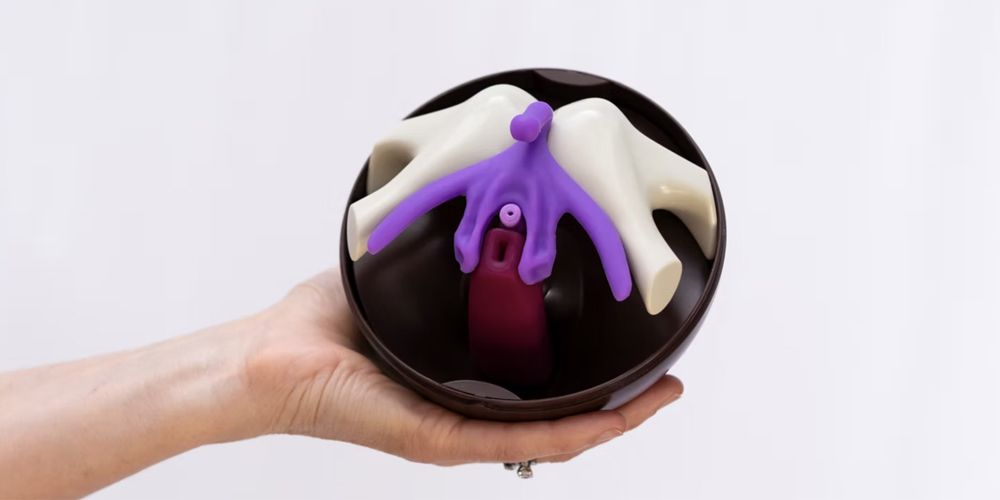
Because anatomy education should keep pace with both the evidence and real bodies, the model is designed to grow. Interchangeable inner labia reflect the enormous natural variation in labial size, shape and colour, countering the narrow range shown in most educational resources. We created a non-engorged clitoris to offer a baseline for discussing changes during arousal and how disability, disease or medical interventions may affect sexual function.
We’ve enjoyed the response to our glow-in-the-dark clitoris. It was inspired by MRI research in which engorged tissue appears brighter on certain sequences, illustrating blood flow during arousal. It has also become a popular novelty gift, affectionately known as a “Clitmas present” for the Christmas tree. Sometimes humour is the perfect way to start an important conversation.
The newest addition, launched in 2026, is the Pelvic Floor Muscle Kit, which clicks directly into the existing model. A deep muscle layer sits beneath the clitoris, and a superficial layer rests over the clitoral body and clicks into the deep layer. Developed after extensive consultation with clinicians and educators, the kit shows how the muscles that support continence, pelvic organs and sexual function relate to the clitoris and surrounding structures. That relationship is notoriously hard to picture from a diagram alone. This latest addition includes an adapted inner labia with enlarged urethral and vaginal openings to demonstrate the use of catheters and swabs.
The design of the Cliterate model and all our expansion packs follows universal design principles. It aligns with neuroaffirming practice, offering multiple ways to engage with information rather than relying on diagrams or verbal explanation alone. Just as importantly, it reduces embarrassment. When a model sits on a desk or is passed around a classroom, people can point, ask questions and explore without relying entirely on words.
From classrooms to clinical consultations
Since 2023, more than 700 Cliterate models have been distributed across Australia and internationally. They are used in universities, medical and allied health clinics, sexual health services, schools and community education programs. We are particularly proud to see Cliterate supporting locally delivered education within Aboriginal and Torres Strait Islander communities.
Its applications go well beyond identifying the clitoris:
- General practitioners demonstrate where to apply treatment for vulval skin conditions.
- Pelvic health clinicians explain pelvic pain and sexual function.
- Sexual health professionals show the anatomy relevant to catheterisation or self-collected cervical screening.
- Educators teach accurate anatomical vocabulary in schools, universities and community settings.
- People with disability gain an accessible way to learn anatomical language, understand medical procedures and take part in decisions about their own care.
Why this matters for everyone
Accurate anatomical knowledge is not a niche concern. It helps people recognise changes in their bodies, describe symptoms clearly, understand medical procedures and make informed decisions about their care. When patients and clinicians share an accurate, common language, consultations become clearer and less awkward for everyone in the room.
It matters for pleasure, too. Sexual health includes comfort, pleasure, autonomy and wellbeing throughout life, including during illness, disability, pregnancy, menopause and ageing. Everyone deserves respectful, accessible information about their anatomy, regardless of gender identity, sexuality, age or ability.
Powered by community
Cliterate is self-funded; as I often joke, it’s the rather expensive baby of Thrive Rehab. Without corporate backing or a large marketing budget, it has grown through the enthusiasm of healthcare professionals, educators, researchers and advocates who believe anatomical education should be accessible to everyone. Because social media platforms frequently restrict educational content depicting sexual anatomy, word of mouth from this community has been vital.
We would love to see Cliterate in more community health services, schools, universities and regional and remote health facilities. If you are applying for grants, fundraising or advocating for sexual health literacy, please consider including a Cliterate model. Helping one community organisation access a model can open conversations that might otherwise never happen.
Where to next?
What began as a solution to an everyday occupational therapy challenge has become an international educational resource. We hope to keep expanding its applications through research, collaboration and accessible education.
Ultimately, everyone deserves accurate information about their body, presented in a way they can understand. It’s time we all became a little more Cliterate!
Learn more, or support a community to become Cliterate, at www.cliterate.com.au.