I’ve got all the resources in the world, come from a family of physicians, and still, it took 27 years to diagnose the medical condition that’s largely steered my life. That’s because it only impacts folks who menstruate (and oops! we haven’t been studied much in medical research). I’m writing this so that you can find help sooner. Please share it with your sister.
The condition is called PMDD (Premenstrual Dysphoric Disorder). For those impacted like me, the wheels fall off in their lives for a week or two a month, and symptoms are relieved when we begin to bleed. I’ve dealt with this from the day I got my first period at 14 years old, and didn’t understand what was happening to me until age 41. It took a 60-thousand-dollar (US!) counselling degree, untold therapy bills, and a final dark night of the soul during the luteal phase of my menstrual cycle as I cried my eyes out at 2am in July of 2020, that first summer of the pandemic. “Luteal” in this sentence matters, a word that was brand new to me, and which loosely translates as “Hell” for folks suffering with PMDD. Scientifically speaking, it’s the second half of a menstruating person’s monthly cycle, when between ovulation and menstruation, an egg travels down the fallopian tubes, marked by a rise and subsequent fall in progesterone. Progesterone has a calming effect on most people, but not so for those with PMDD. In my case, and one in twenty menstruating others, it wreaks total havoc on the emotional centre of the brain. A peer shared, “in a couple short weeks a month, I can destroy my whole life.”
Living with PMDD is like having an awful roommate (that you didn’t know was there and who never pays the rent). Over the years, I’ve had some pretty shitty roommates. There was the one in Boulder who had homicidal thoughts and the one who snuck up on me in the kitchen and always smelled sour. There was also the bully who kicked me out and blended smoothies by my bedroom at 5am. (Not to mention the one who walked in while I was masturbating and just stayed there.) None of them though, had anything on the PMDD roommate that’s lived with me for three decades. With the others, I was always free to move out. PMDD empties my home of Kleenex, eats all my chocolate, trashes my kitchen, and, on occasion, breaks up a friendship or leaves a Dear John letter for my boyfriend. For a couple weeks, she’ll leave and my house will be in order. I’ll start to make plans with friends, feeling strong and resilient. I may even apply for a new job. In these brief lulls, I’ve felt great joy. But then she strides back in without knocking, blowing the door off its hinges. I dread her return, tensing when her tires crunch the gravel driveway. Over the years, I’ve become so afraid of my roommate’s return that my life has begun to feel like a house of cards. It makes it scary to start school, a job, a new relationship, or even a project, because I don’t trust that she won’t show up and ruin everything. She has a way of pulling the rug out from under me, leaving me sobbing in bed, or so anxious I struggle to breathe.
I went to the doctor
“I’ll give you a moment to collect yourself,” says the latest kind doctor as I lie sobbing on the crunchy cold paper of the examining table, having received yet another mental health diagnosis. I feel shattered, my alphabet of diagnoses growing longer. I had the ABCs with Anorexia, Bipolar II and Cyclothymia, and now she’s pronounced atypical Depression.
I’d gone in asking for a prescription for birth control, “I really think the issue is my hormones,” I’d said, after scratching out my symptoms in red ink on my calendar for a year.
She’s not the only one who missed my PMDD diagnosis. Four psychiatrists, three psychics (regrettably), two naturopaths, six counsellors, five MDs and one traditional shamanic healer from the Amazon all missed it too. To her credit, the Amazonian healer came the closest when she said that I had to come to terms with being a woman by embracing my sacred, divine life force. Though I didn’t love her suggested method — finger painting with my own period blood — I gave it a try, because I was just that desperate.
14:41
When I got my first period at 14 years old, wishing I hadn’t, my mom said it was like a switch had flipped. “You were like a different person.”
That’s when I started counting to five before walking through a door (if I didn’t do it, something bad might happen, like one of my parents could die). I ate less and less and swam more and more. My brain caught fire and I couldn’t put it out. I survived one of the most fatal mental health diagnoses: Anorexia, which I now know often presents as comorbid with PMDD. (As does Seasonal Affective Disorder – and, go figure, ADHD, take note friends!)
In my 40s now, I’ve had to grieve not getting to the root of this sooner. It wasn’t for want of digging, nor for lack of support from loving family and kind, skillful practitioners. It’s that we were all operating under the same flawed and false assumptions. When I first felt its physiological pinch, PMDD had not yet been considered, much less understood. It wasn’t until, “…a landmark decision in May 2019”, that The World Health Organization finally added Premenstrual Dysphoric Disorder to the International Statistical Classification of Diseases and Related Health Problems.
They say it was complicated because the condition straddles different disciplines: does it belong in the field of endocrinology? Gynaecology? Is it a mental health issue? The truth is that it requires a multi-disciplinary approach. But first you have to care. (Dig for one minute into this and you’ll see that it stems from the same reason that more women than men die of heart attacks. I suggest reading Invisible Women by Caroline Criado Perez.)
I went to the mountain
At 19, I quit university and moved to the mountains. (I’d missed so many morning classes lying weeping in my dorm room that it only made sense.)
With my bare feet on the earth, I simply felt better. Outdoors I could simply be me, freed of rules, expectations and all the “shoulds” shouted by society (except for the ones I’d accidentally swallowed). I skied and paddled, and in seeking out snow, rivers, and awe, I regained perspective. In nature, there is only beauty and survival. Nothing else matters. Gender, time, and the patriarchy are abstract concepts out there, not crushing us into tiny boxes the way they do indoors.
I got a degree in outdoor pursuits, and later went on to specialize in wilderness therapy, because all I want to do is to be with people in the forest, walking them home, helping them remember who they are. On the land I don’t need language, I don’t need a label, I just step outside and feel a little bit, “closer to fine”.
That’s me in the corner
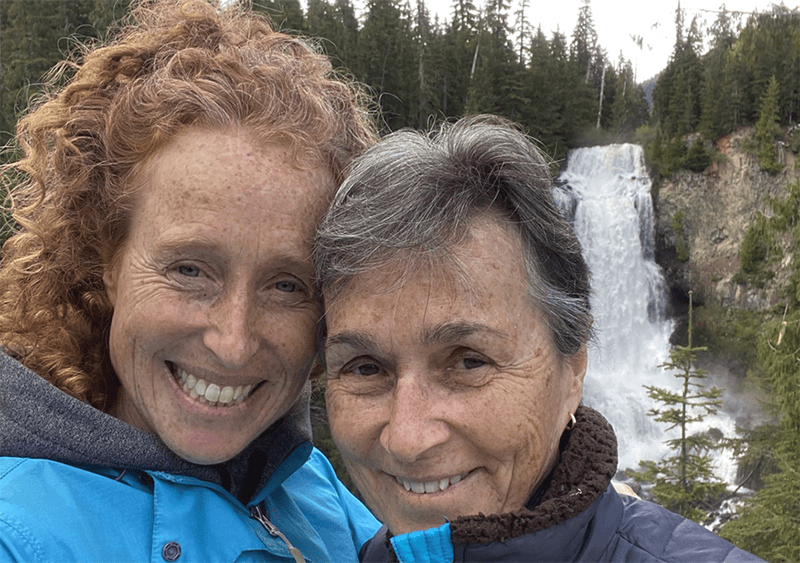
In the middle of July, at 2am, I lay crying in our family cottage. I’d holed up there to weather the first few months of the pandemic with my parents, my sister and her family. They slept just down the hall from me, as I soaked the pillow and stifled my sobs.
“I can’t believe this is my life,” I thought, 41 and jobless, single without prospects. Up to that moment, I’d always thought I’d be ok, that I’d meet someone in the end, that I wouldn’t spend my life alone, and that one day, things would get better. But that night, I realized they might not. Hope dies hard, I think they say.
It sure does. I’ve always prided myself on being hopeful and used to operate as though I’d die trying. Whether it was what I learned at the Buddhist school I attended, or more likely, that I just got too exhausted to try any longer, something shifted that night. I surrendered. I think that’s when I first let go, and began to grieve all those things that didn’t or hadn’t yet happened: falling in love, choosing a home, becoming a mother…
So I sobbed into my pillow all night long, and then I leaned in to ask PMDD what she’d been trying to tell me all along. And in the morning, I walked over to my mom and asked her for help.
Me & PMDD
Me: Wow, you waited 27 years to tell me, eh?
PMDD: Yeah, well, you’re the one who wrote that piece, “Ripe” about how things can only happen once it’s time. It had to be now.
Me: But you hurt me! I’ve suffered for so long.
(a tear falls.)
PMDD: I know honey. But I didn’t come here to hurt you. I’m only here to wake you up.
Me: Wake me up? What’s that supposed to mean?
PMDD whispers softly: It’s time for you to reclaim your power.
(I start to sob softly.)
Me (quieter now): I’m getting older. There’s so much in life I may have missed. Why did it have to take so long?
PMDD: Honey, you can’t peel a cocoon off a caterpillar. You’ll fly in time. Rest now.
Rest.
And so I do. I sleep. And each morning dawns a little brighter than the morning before.
(the end. the beginning.)
Post script: pitching a red tent
With a first degree in outdoor pursuits and a second in wilderness therapy, I’ve spent a lot of years pitching tents. Here’s my final pitch: it’s time to put up a lot more red tents. We need spaces where we can step into caring community, and feel held and heard and heal. We need to start to speak about that which was once sacred but that power has made taboo: dreams and blood and babies, and we need to celebrate and grieve together. PMDD is just another word, even a label if used poorly, but the great thing about it is that it is leading me to community, and I believe that it’s in wild community that we heal. As I blaze my trail forward and step closer and closer to fine, you can bet your bottom dollar that I’ll be leaving trail markers as I go. Because honeys, it shouldn’t have to be so hard. I think it all starts with story. And I’m telling you, now that I’ve got language for this, I’m not shutting up.